 bbms@bluebells.org
 0124 - 46 98 888


The Blue Bells curriculum framework is designed to bring learning to life by enabling students to develop deeper cognitive abilities across key priority areas such as creativity and problem-solving, language and communication, physical and motor development, and social-adaptive learning. These domains collectively support strong academic growth and lifelong learning.
The school offers an age-appropriate, enriched curriculum where learning is a joyful and engaging experience. Classroom practices are thoughtfully designed to foster curiosity, self-expression, joy, and aesthetic sensibility, ensuring that students remain motivated and actively involved in their learning journey.
Core Principles of Transformative Pedagogy

Critical Reflection
At Blue Bells Model School, reflection is central to meaningful learning. Students are encouraged to think deeply, question assumptions, and connect classroom learning with real-life experiences. Emphasis is placed on understanding concepts rather than memorisation, enabling learners to apply knowledge with clarity and confidence. Continuous feedback supports growth and self-awareness.

Dialogue and Collaboration
Our classrooms thrive on dialogue, discussion, and teamwork. Students are encouraged to share ideas, debate respectfully, and collaborate to solve problems. Through interdisciplinary projects and cooperative learning, they develop communication skills, empathy, and the ability to work effectively as part of a team.

Empowerment
We empower learners to take ownership of their learning journey. Carefully designed enrichment programmes and personalised support help each child realise their potential. With a strong focus on global citizenship and awareness of contemporary issues such as the SDGs, students grow into responsible, compassionate, and confident change-makers.

Action-Oriented Learning
Learning is hands-on, engaging, and future-focused. Students connect knowledge with real-life applications through skill-based learning such as Financial Literacy, Artificial Intelligence, Design Thinking, and Coding. This approach nurtures creativity, problem-solving abilities, initiative, and resilience.

Cultural Relevance
Rooted in India’s rich cultural and artistic heritage, our curriculum blends traditional wisdom with a modern global perspective. Students develop a strong sense of identity while learning to respect diversity. Exposure to liberal arts fosters appreciation for beauty, balance, harmony, and cultural understanding.
Key Strategies for Implementation
Problem-Posing Education
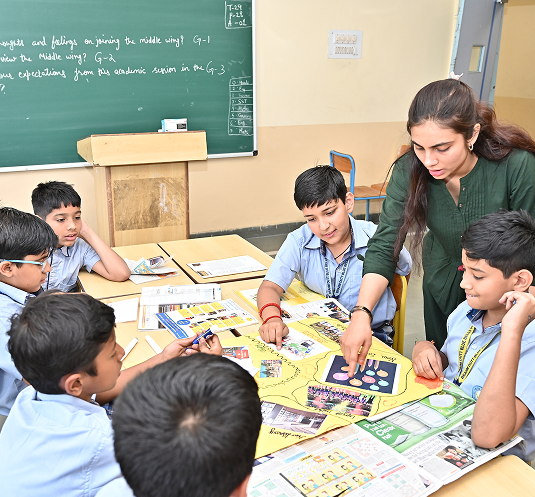
Learning at Blue Bells Model School begins with questions rather than answers. Students are encouraged to identify problems, analyse situations, and explore multiple solutions instead of passively receiving information. Teachers act as facilitators, guiding learners to think critically, question assumptions, and relate academic concepts to real-life situations. This approach nurtures independent thinking, curiosity, and deeper conceptual understanding.
Experiential Learning
Students learn best by doing. Through hands-on activities, experiments, field visits, projects, and real- world simulations, learning becomes meaningful and lasting. Experiential learning allows students to connect theory with practice, apply concepts across subjects, and develop problem-solving skills. These experiences help learners gain confidence, creativity, and practical understanding beyond textbooks.
Narrative and Storytelling
Stories are powerful tools for learning and connection. Lessons are enriched through narratives, role plays, case studies, and real-life examples that make abstract concepts relatable and engaging. Storytelling enhances imagination, language skills, emotional intelligence, and moral reasoning, enabling students to internalise learning in a natural and memorable way.
Collaborative Projects
Collaboration lies at the heart of our learning culture. Students work together on interdisciplinary projects that encourage teamwork, communication, and shared responsibility. Collaborative projects promote respect for diverse viewpoints, collective problem-solving, and leadership skills, preparing students to work effectively in academic, social, and professional environments.
Reflective Practices
Reflection transforms experience into learning. Through journals, class discussions, self-assessment, and feedback, students are encouraged to reflect on what they have learned and how they have learned it. This process builds self-awareness, responsibility, and a growth mindset. Teachers also engage in reflective practices to continuously refine teaching strategies and support every learner’s progress.
Benefits of Transformative Pedagogy
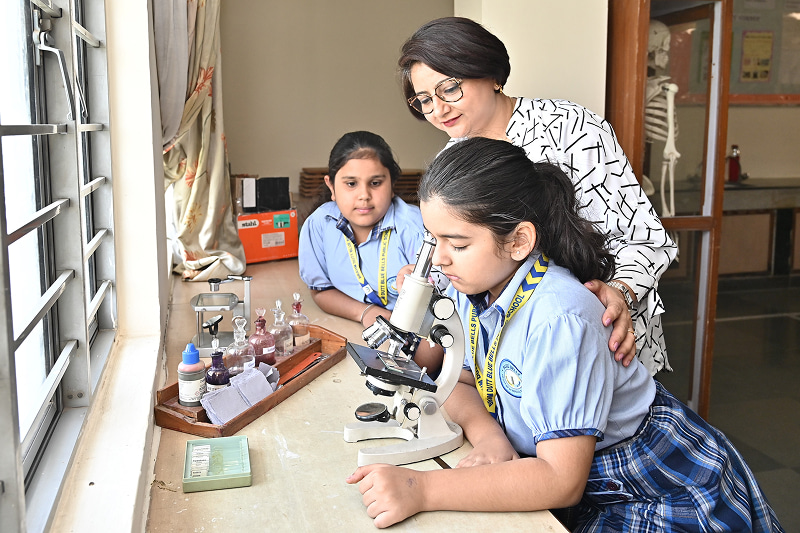
Through progressive and transformative learning practices, Blue Bells Model School remains committed to its vision of nurturing confident, competent, and responsible learners equipped with the skills, values, and knowledge required for success in the 21st century.
- Emphasises student-centred and experiential learning to foster critical thinking and creativity.
- Integrates 21st-century skills such as communication, collaboration, digital literacy, and problem-solving.
- Promotes values-based education, nurturing empathy, integrity, and social responsibility.
- Encourages holistic development through academics, arts, sports, and life-skills programmes.
- Adopts innovative teaching methodologies and continuous professional development for educators.
- Creates a safe, inclusive, and supportive learning environment that builds confidence and independence.